What AI Website Builders Can't Do for Your Business
The pitch is appealing: describe your business in a few sentences, pick a color palette, and walk away with a website. AI-assisted builders like Wix ADI, Hostinger Horizons, and Framer AI have gotten genuinely competent at producing something that looks finished. For a pop-up event or a placeholder page, that competence might be enough. For a small business that depends on its website to convert visitors, rank in search, and reflect the actual quality of its work, the gaps show up fast.
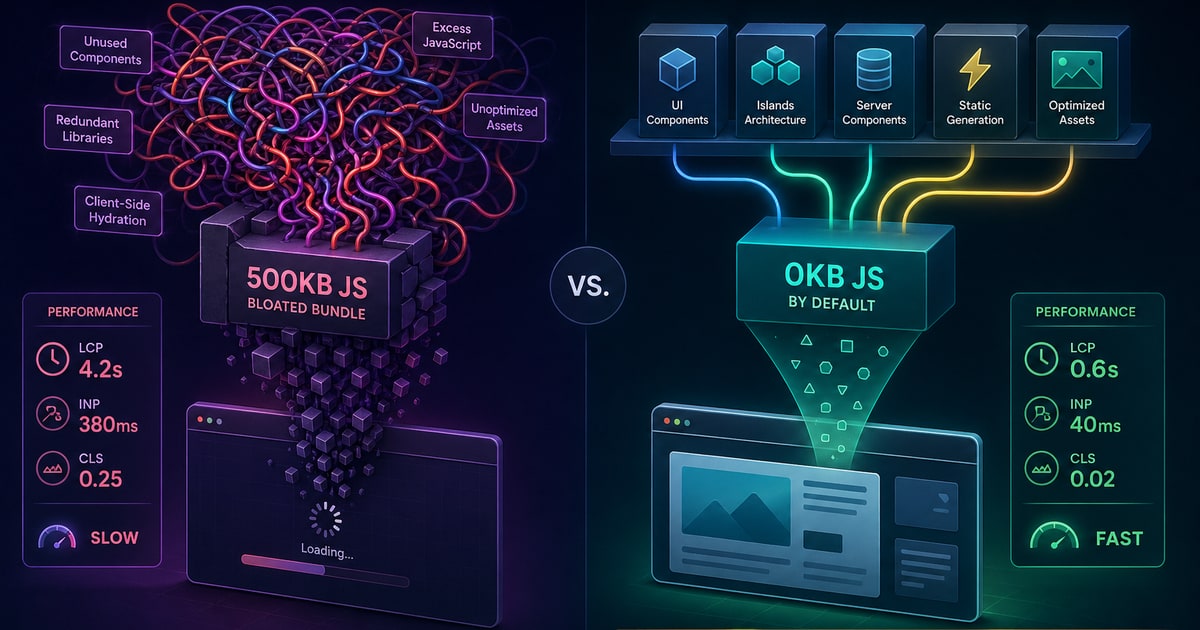
The most immediate gap is performance. AI builders generate markup the way a nervous student writes an essay: padding everywhere, nothing cut. A typical site produced by an AI builder arrives in the browser with hundreds of kilobytes of JavaScript that runs before the visitor sees anything meaningful. Google’s Core Web Vitals scores reflect this. An Astro-built page, by contrast, ships zero JavaScript by default and adds interactivity only where it’s genuinely needed. That’s not a philosophical preference; it’s a measurable difference in how quickly your page loads on a mid-range Android phone on a 4G connection, which is how a significant portion of your customers are actually visiting. A slower page means a higher bounce rate, and a higher bounce rate compounds every other marketing effort you’re making.
The Decisions a Prompt Can’t Make
Beyond performance, there’s the question of judgment. An AI builder can produce a layout that looks correct, but it can’t ask you why a particular service is buried three clicks deep, or notice that your pricing page creates confusion rather than confidence. Those observations come from someone who has shipped enough websites to recognize a structural problem before it becomes an analytics problem. When a developer is building your site by hand, every element is a decision: what loads first, what gets indexed, what a screen reader encounters, what happens when someone visits on a 1024-pixel-wide laptop rather than a phone or a widescreen monitor. AI tools approximate these decisions; they don’t make them.
There’s also the matter of what happens after launch. AI-generated sites tend to exist inside proprietary ecosystems. Your content, your styles, and sometimes your domain are tied to a platform whose pricing or feature set can change at any time. A custom-built site on a stack like Astro and Tailwind, deployed to something like Cloudflare Pages, is genuinely portable. The files are yours. The logic is readable. Another developer can pick it up without decoding a black box. That kind of independence is worth something when your business grows and your needs change.
What You’re Actually Paying For
None of this means AI builders have no place. For a founder who needs a personal site this week with a $0 budget, a prompt-driven tool is a reasonable starting point. The problem is when that starting point becomes permanent because switching feels complicated or expensive.
At Concepcion Design, we’ve seen this play out with clients over the years. AI tools can get you started, but they rarely scale with real business needs. That’s why our custom projects on Next.js, Astro, or fully bespoke stacks come with actual reasoning behind every choice, plus ongoing partnership when things evolve.
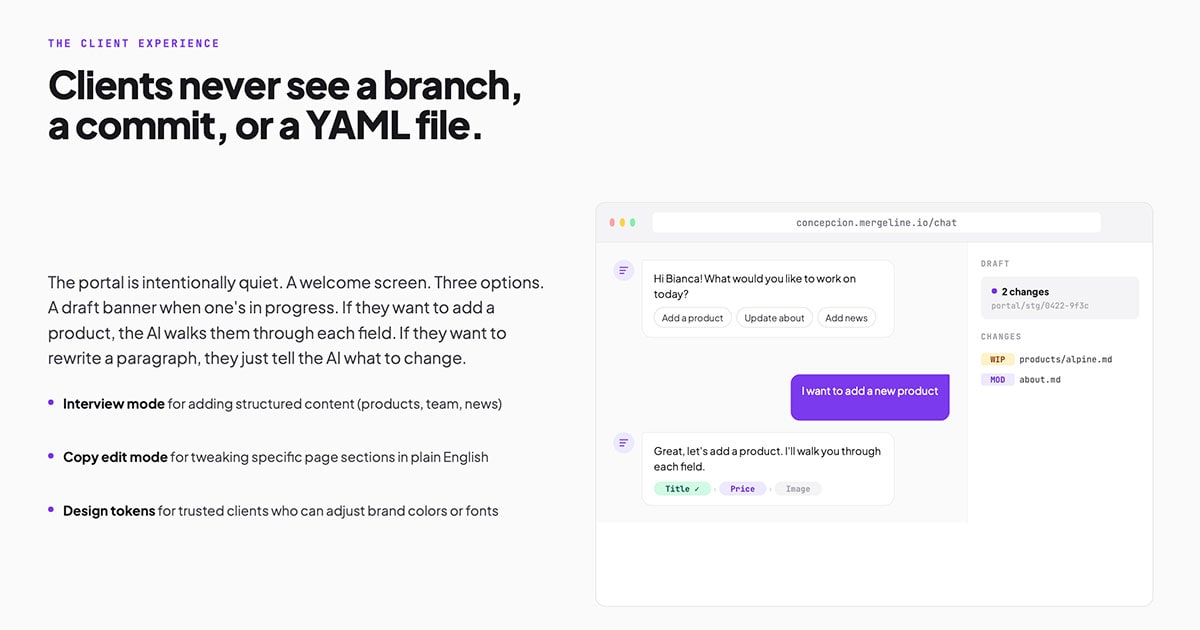
For small businesses that need more than a polished placeholder, we’re also building Mergeline to bridge the gap entirely. It gives you the performance of a static site with intuitive editing that feels as simple as those AI prompts, but without the vendor lock-in or bloat. Update your own content anytime through a clean interface that handles rebuilds automatically. No subscriptions creeping up. No black-box decisions. Just a site that works as hard as your business does, two years from now.
The businesses that get the most out of a custom-built site are the ones that treat their web presence as infrastructure rather than a checkbox. They want a developer who knows why a decision was made, can change it quickly, and will still be available two years from now when something needs updating. That’s a different kind of relationship than submitting a prompt and downloading a ZIP file, and for most small businesses with real customers and real revenue at stake, the difference is worth understanding before committing to either path.
