11,000 WordPress Vulnerabilities in One Year
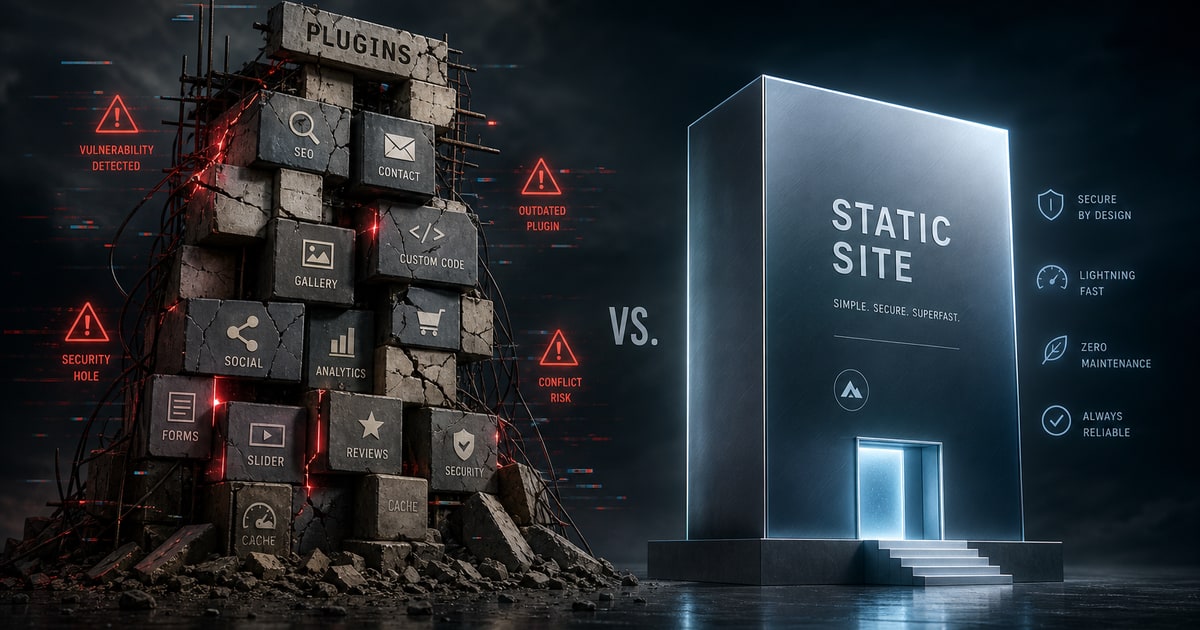
SolidWP’s 2025 security whitepaper put a hard number on something many developers had long suspected: WordPress accumulated 11,334 documented vulnerabilities in a single calendar year. The majority trace back to plugins and themes, the same ecosystem that makes WordPress feel flexible and powerful. That flexibility is also why the attack surface is effectively unbounded. Every plugin you install is a third-party codebase you are now responsible for patching, monitoring, and trusting indefinitely.
For small business owners, this rarely registers as a strategic risk until something goes wrong. A contact form plugin goes unmaintained. A theme vendor quietly abandons a product. A zero-day surfaces on a Friday afternoon. The site gets injected with spam links or redirects, Google flags it, and the search rankings built over months take a serious hit. By the time the cleanup happens, the damage is done. The 11,334 figure is not a warning about edge cases. It is a description of normal operating conditions.
The Plugin Model Is the Problem
WordPress’s vulnerability problem is not a bug in the software so much as a structural consequence of how it works. The core platform depends on plugins for nearly every functional extension, from contact forms to SEO tooling to payment handling. Each plugin represents a dependency with its own release cadence, its own security posture, and its own potential to introduce a flaw. Multiply that across a typical business site running fifteen to thirty plugins and the math becomes uncomfortable quickly. Patching is not a one-time project. It is a recurring operational cost with no finish line.
A static site built with Astro and deployed on Cloudflare Pages does not have this problem because it does not have plugins. There is no database to inject, no PHP runtime to exploit, no admin panel exposed to credential-stuffing attacks. The site is a collection of pre-rendered files served from the edge. The attack surface is as close to zero as a production website can get. That is not a marketing claim. It is a consequence of how the architecture works.
Security as a Build Decision, Not a Maintenance Plan
Most small businesses treat website security as something managed after launch: auto-update plugins, run a scanner, buy a firewall subscription. That approach assumes the underlying platform is sound and the risk is manageable through vigilance. SolidWP’s data challenges that assumption directly. When a platform generates thousands of new vulnerabilities annually, the maintenance plan is not a solution. It is a coping strategy.
Choosing a static architecture from the start changes the frame entirely. Security stops being a recurring line item and becomes a property of the build itself. There are no credentials to rotate, no plugin changelogs to review every Monday, no hosting firewall rules to configure against the latest threat. For a small business owner who is not running an IT department, that reduction in operational overhead is significant. It also removes a category of SEO risk that most owners do not think about until a site gets flagged. A compromised site can lose ranking overnight. A site with no exploitable surface does not get compromised in the same way.
If you are running WordPress because it was the default choice years ago and not because your project genuinely requires a CMS with that footprint, the 2025 vulnerability count is a reasonable moment to reconsider. The tools available now, Astro for static generation, Cloudflare Pages for global edge delivery, headless CMS options for clients who need content editing, make a clean and fast alternative more practical than it has ever been.
Build what holds up. Details at https://concepcion-design.com.
